




The street sign was in the part of the scrapyard where the bricks, stones, and retired street signs end up. It was also where customers aren’t supposed to wander.
Joseph Jeffers was in Wilmington that day, dropping off drums of contaminated soil from a wetland remediation job, when he found it. He liked the name.
So he tossed the sign in the back of his truck, covered it with scrap metal, and paid for it by weight.
Then he sent a photo of it to his friend Drew Maykuth.
“I said yes,” Drew recalls.
Prior to Joseph’s trip to the scrapyard, the business partners and friends had been trying to come up with a name for their new restaurant. “We had hundreds of them,” Joseph says about the long list of discarded choices discussed over dinners with friends and loved ones. “Nothing.”
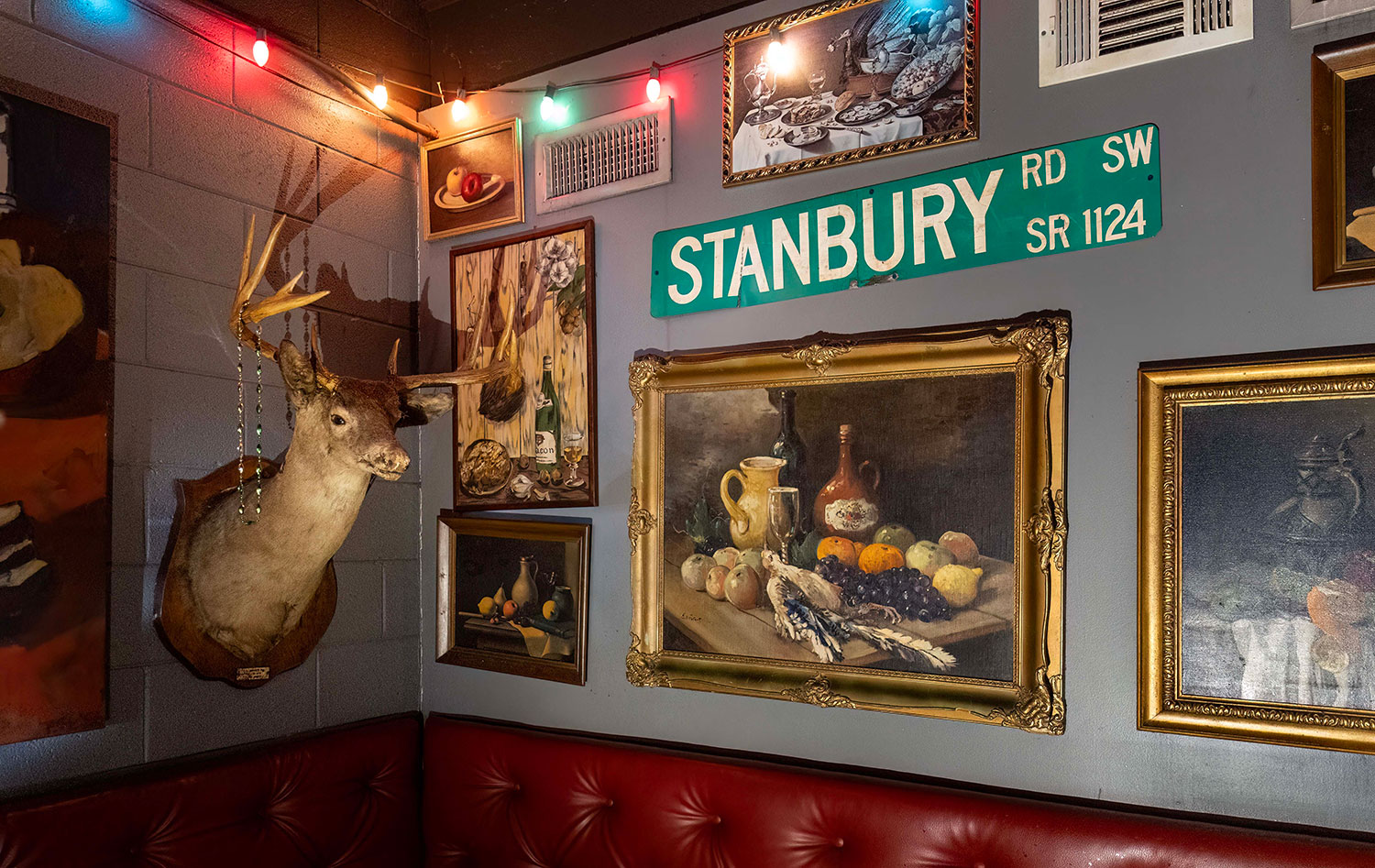
The street sign that gave the restaurant its name, salvaged from a Wilmington scrapyard, hangs above a gallery wall of still lifes, while a bead-draped antler mount keeps watch from the corner.
Then came the scrapyard, the truck bed, and Drew’s instantaneous, one-word reply.
Today, Stanbury “can mean whatever you want it to,” Joseph says. For many, it’s culinary excellence after the restaurant earned a Recommended honor in the first-ever MICHELIN Guide American South in 2025. For others, it’s the restaurant’s unexpected physical presence in the historic Mordecai neighborhood, where N. Blount Street offers impressive camouflage.
Somewhere out there is presumably a real street that once answered to Stanbury, but no one is in any hurry to find it. The sign itself is still around, hanging on one of the restaurant namesake’s rustic walls.
It’s a fitting origin story for an establishment that has made quirky eclecticism its house style. The three men behind it — Joseph, his brother Will, and Drew — had, by their own admission, no long-held vision when they started. “Zero,” Joseph says. “Really, zero.”
What the enthusiastic trio had instead was authenticity, and a habit sturdier than any established business plan: saying yes.
Not for Everyone
The practice of saying yes predates the restaurant by more than a decade. Joseph, Will, and Drew all passed through Warren Wilson College, the Swannanoa “farm college,” as Joseph describes it, where everyone works to earn credit toward tuition. Although they didn’t attend at the same time, as freshmen Joseph and Drew were on the kitchen crew, with the former cutting onions and the latter running an omelet station.
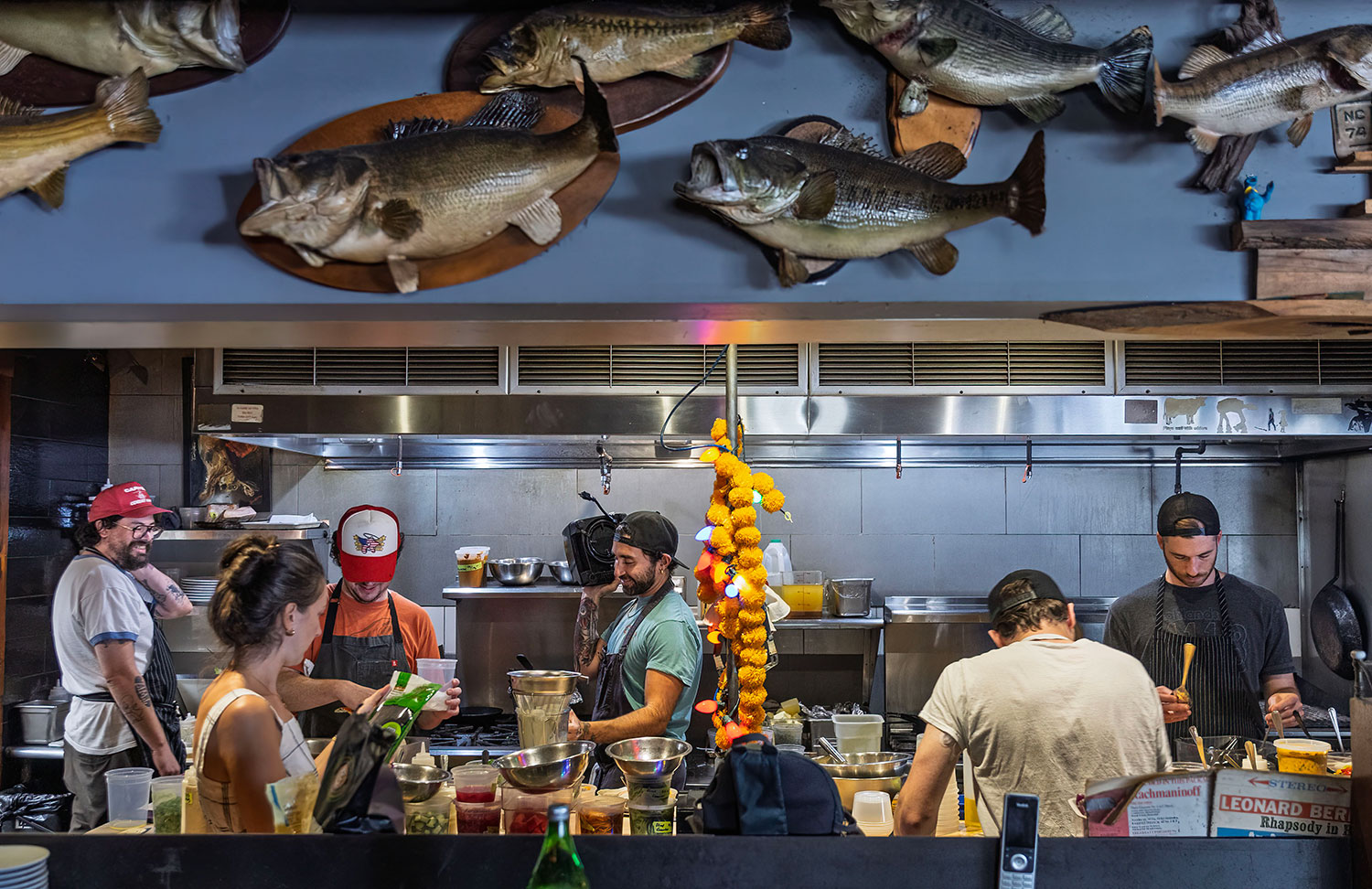
An open kitchen is exactly how Drew Maykuth prefers it — nothing to hide, a mounted lineup of taxidermied bass overhead, and a crew of seven working the line shoulder to shoulder during prep.
After they graduated from the mountain school whose former motto was “We’re not for everyone, but maybe you’re not everyone,” they connected in Raleigh. It was about 15 years ago, and Drew was fresh from cooking in Asheville, where he’d led the kitchen at The Admiral. After a stretch in Maine, he stopped in to visit a friend here and ended up sticking around for several months and helping Joseph fix up a house.
The first thing Drew cooked that Joseph remembers eating was squirrel, shot in a downtown cemetery and served for brunch before they watched the Oscars together.
Perhaps the most consequential meal, however, came in early 2013 when, one Sunday, Will ate brunch at Market, a former laundromat/convenience store. It was, serendipitously, the neighborhood restaurant’s very last service.
While there, Will got to talking with the owner, who was selling the lease. That night, he called his brother in Wilmington. “We just kind of had a 20-minute conversation,” Joseph says. “And did it.”
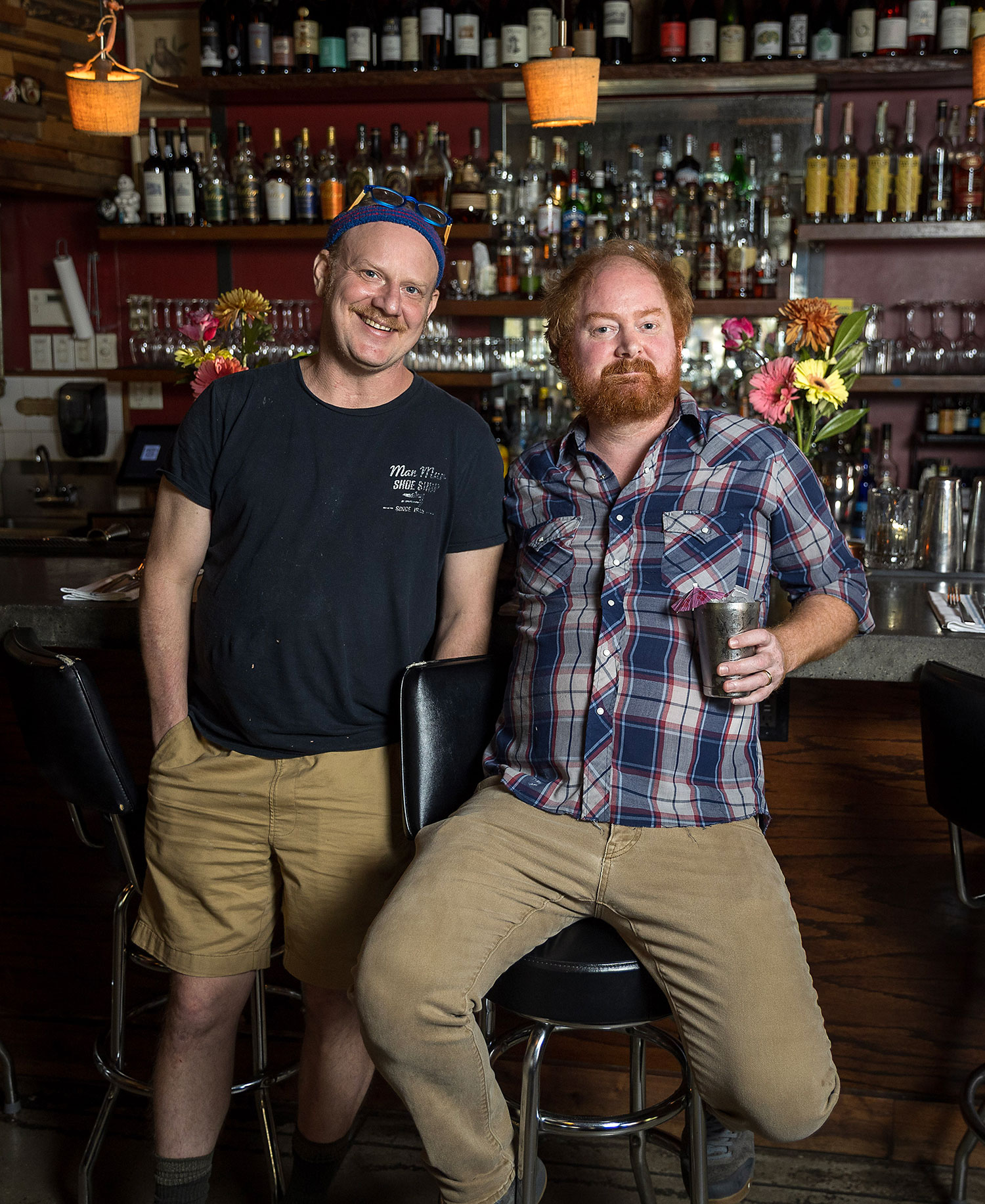
Partners and friends Drew Maykuth (left) and Joseph Jeffers
From brunch to signed lease, it took “a couple days” by Joseph’s count. According to a more generous Drew, “maybe like a week.”
Either way, it moved faster than most people choose a couch.
Blind Excitement
None of them had run a restaurant before. Joseph had been a horse farrier and an arborist before moving into wetland remediation. Will was building houses.
“It was a very steep learning curve,” Joseph admits.
Drew, self-taught, had been in kitchens since he was 15. His contribution, he explains without a hint of ego, was this: “I knew how to cook.”
In “blind excitement” he created the menu the week before Stanbury opened. “I remember specifically opening the doors for the first time and thinking, I hope people come,” he says.
People did come, and several of the items on that first menu remain fixtures to this day. For a restaurant that changes its single-sheet menu as frequently as Stanbury does, that’s really saying something.
Now, more than a decade in, Joseph is circumspect. “We’ve been really good at pivoting,” he says about the restaurant’s remarkable stickability, “because we never had an end goal.”
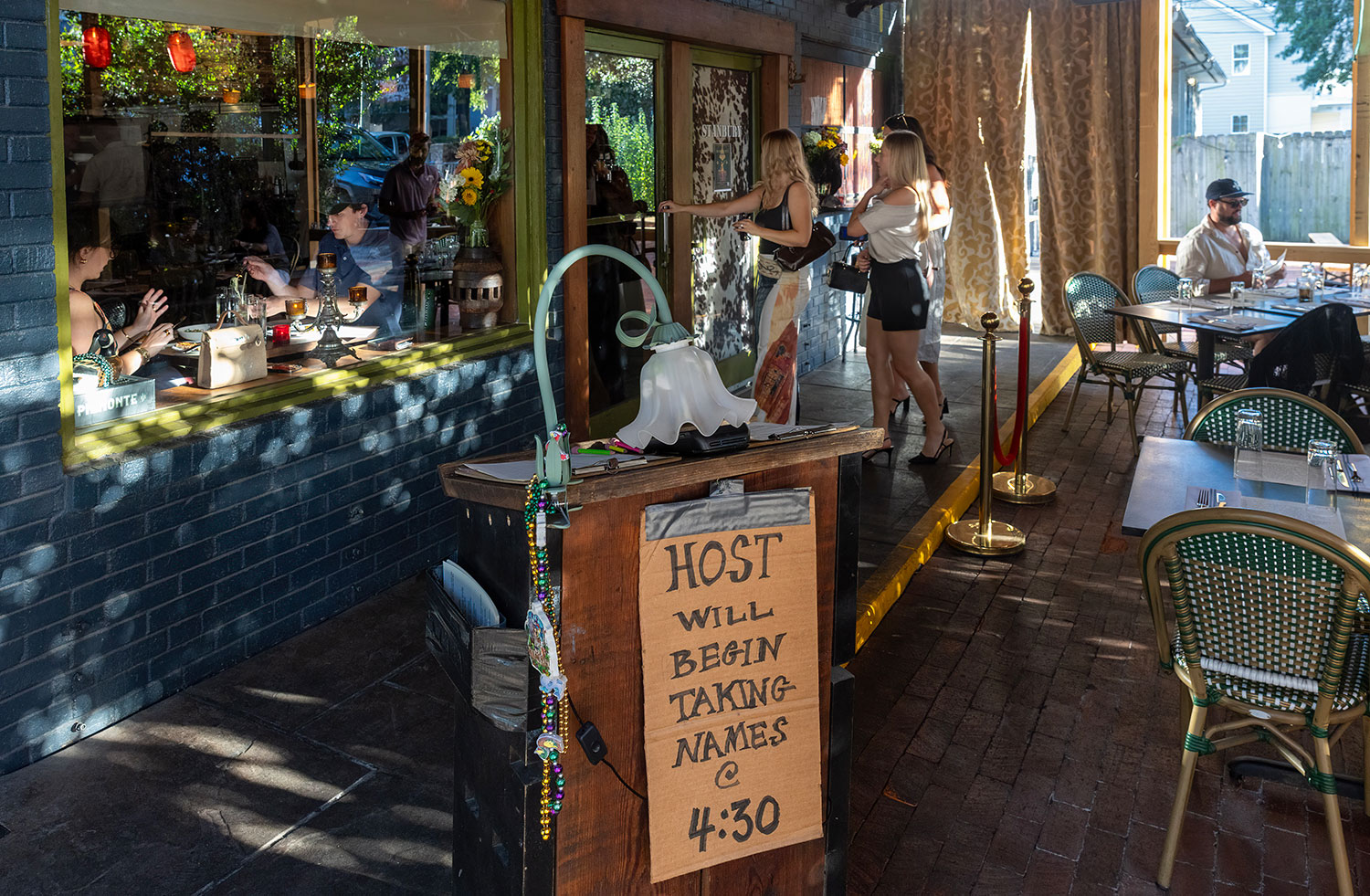
There’s no call-ahead reservations at Stanbury. Instead, guests queue on the sun-dappled patio as they await their table.
For Drew, saying yes is akin to a life philosophy. “I say yes lots of times, and I’ll end up in crazy places because of it,” he admits, but that’s also “how I’ve been really lucky in my life.”
Although Stanbury came from no grand vision and is yet another example of “Oh, why not?” in practice, there was a stretch of time when he wasn’t sure what he wanted to do with his life. (Though, looking at photos on his phone of him as a young child cooking in his mother’s kitchen, it would seem obvious that his anthropology degree from Warren Wilson wouldn’t be how he earned a living.)
A Lab Back There
What does a restaurant with no preexisting vision cook? Whatever’s good this week. “Seasonal, obviously, is number one,” Drew says, with vegetables featuring more heavily during the warmer months and proteins taking center stage in the winter.
On the evening Wake Living visited, Drew mentioned that tomatoes had just a week or two left. The kitchen, he says, was already leaning toward “warmer, heartier, punkier stuff” — squash, apples, pork cheeks, and cider — but one of their favorite things is when a purveyor calls and “is like, ‘Yo, we got the chanterelles.’ All right,” Drew says, “we’ve got a challenge.” (The chanterelles, it should be noted, lasted three days.)
The staff pitches dishes, too. “I have ultimate say and stuff,” Drew explains, “but I want people to go out and eat at other restaurants and get excited and bring ideas in.”
If saying yes explains what could be viewed as impulsive decision making, curiosity explains the sustained creative engine behind the kitchen. Drew describes himself as someone who reads constantly, chases unfamiliar ingredients and cuisines, and treats cooking like a hybrid of art and science.
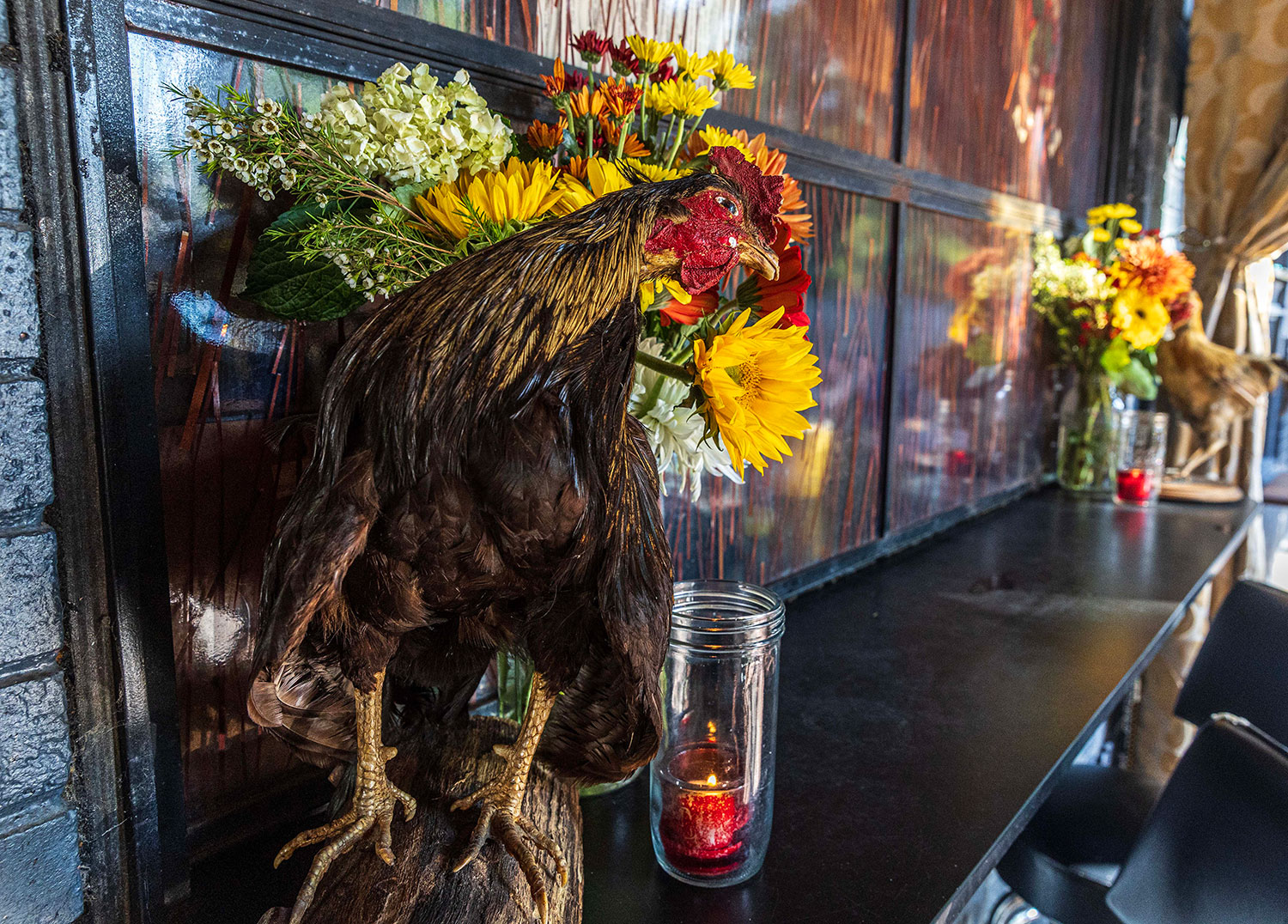
Taxidermy, candlelight, and fresh-cut flowers are just a few examples of the eclectic, unfussy décor that gives Stanbury its lived-in warmth.
“I almost feel like that’s a lab back there,” he says, gesturing toward the kitchen, before going on to describe each ingredient as “almost like a different paint” and the cooking process “like the alchemy.”
Spirit of Experimentation
Though what’s on the plate shifts with the season, or even the mood of the kitchen, a handful of dishes have remained since day one.
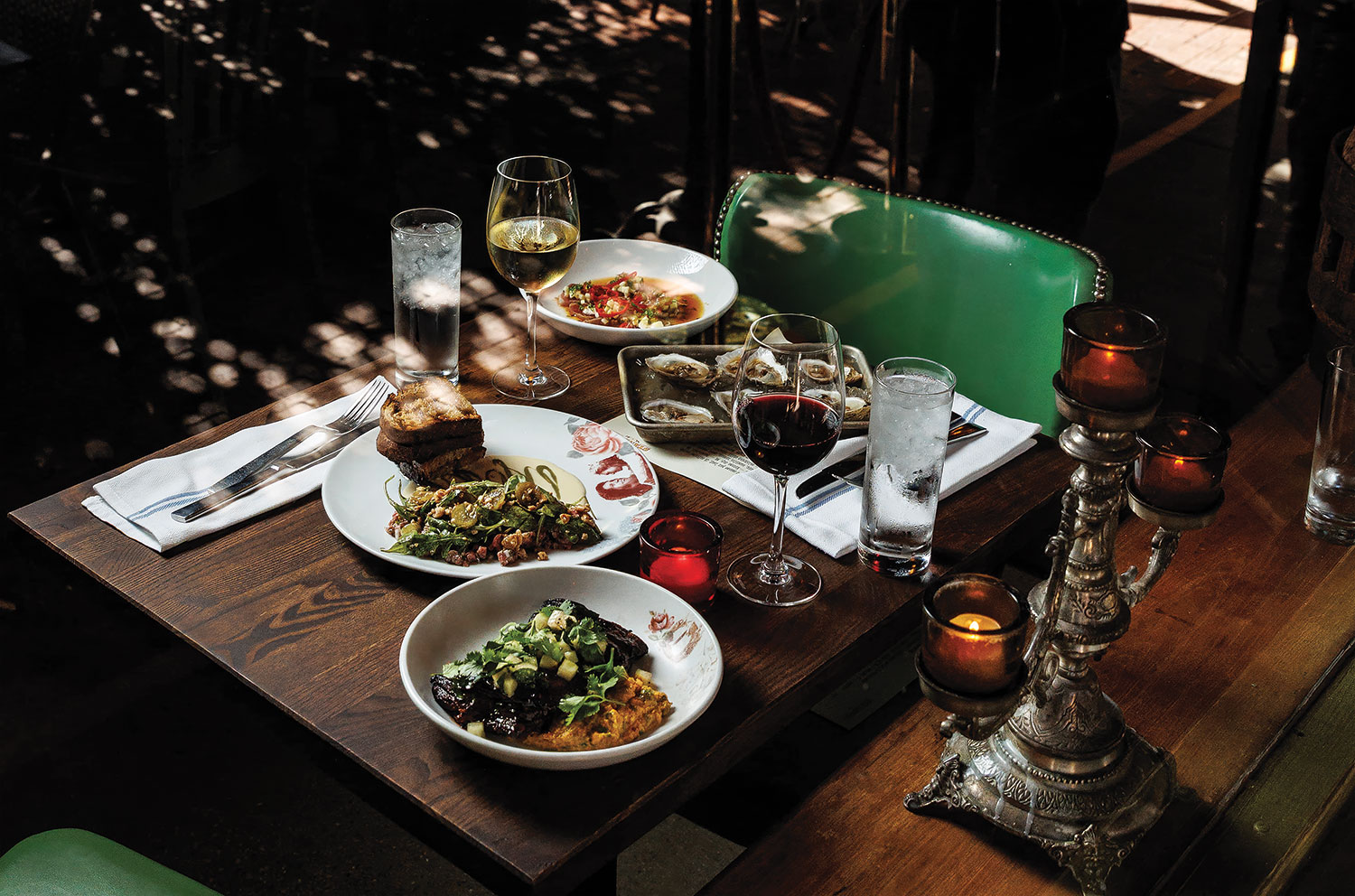
The raw oysters arrive bedded in crushed ice with mignonette and a lemon wedge. The crudo — thin-sliced tuna pooled in a citrus-soy ponzu, scattered with Fresno chile, scallion, diced apple, and crisped shallot — plays color against the kitchen’s more subdued plates. The tartare, piled high with arugula, grapes, and toasted walnuts over a bright, herb-flecked crème fraîche, comes with grilled bread for scraping the plate clean. And the rib eye, blackened at the edges and finished with a melting wedge of soft cheese, is plated alongside more grilled sourdough and an heirloom tomato salad sharp with shallot and basil.
Served in the spirit of a bánh mì, the fried oysters also stake their day-one claim. As does the crispy pig head, which Drew invented a week before opening, having never made it. “I literally don’t know why I put that on the menu,” he admits. “It ended up being good.”
On our team’s visit, that spirit of experimentation showed up elsewhere on the table: lacquered, charred short ribs finished with a bright cucumber-cilantro relish, set beside a golden squash purée; a crispy fried cutlet sharing a plate with its blistered, chile-crusted cousin, both resting on creamed corn with a tangle of pickled cucumber and cherry tomatoes.
Dessert, when there’s room, might be a dense olive oil cake draped in warm blackberry compote, a scoop of vanilla alongside.
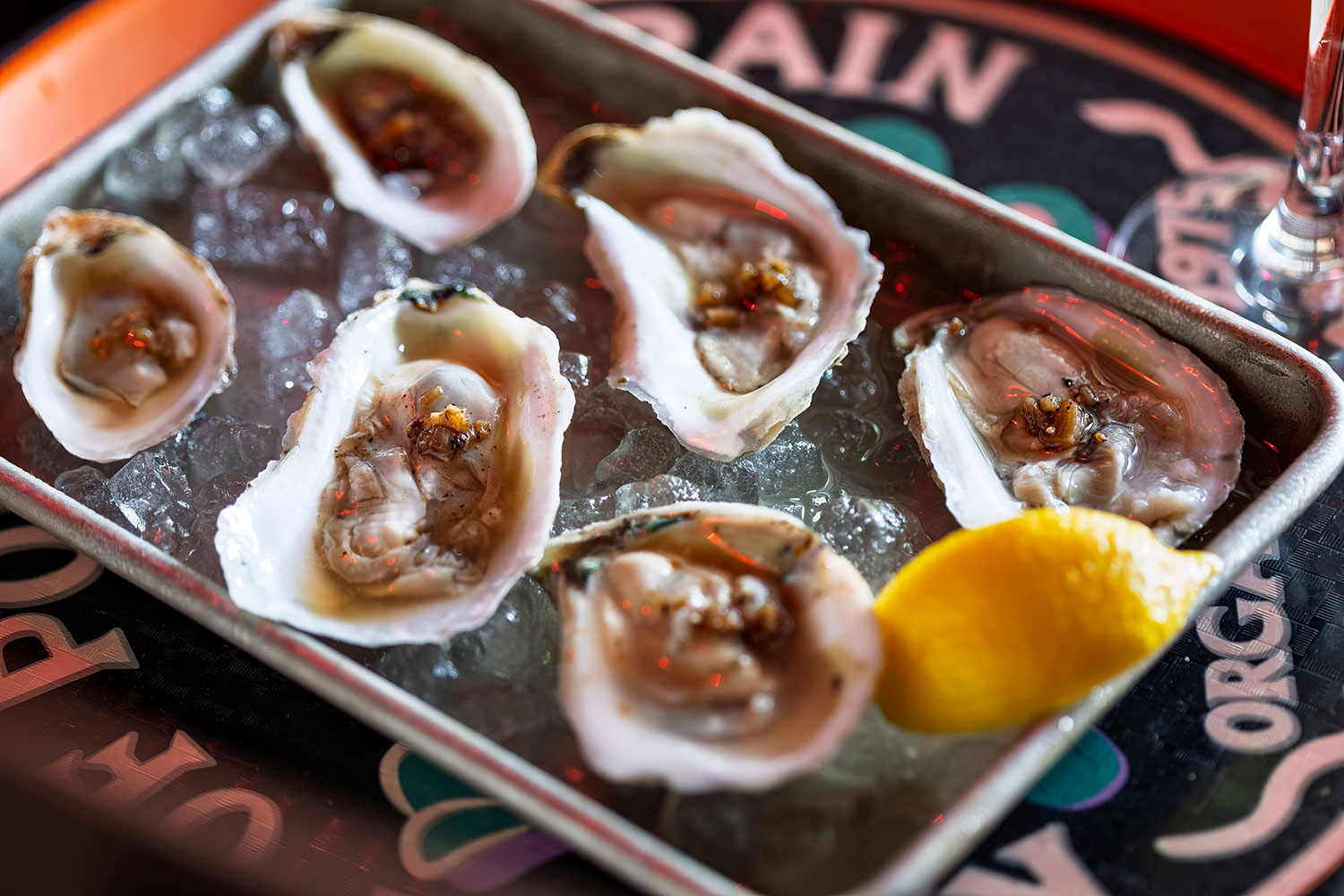
Raw oysters on ice, finished with a savory mignonette and a lemon wedge, have stayed on Stanbury’s ever-changing menu since the doors opened.
Then, as might not be totally unexpected with Stanbury, comes the plot twist. “Ironically, for as much meat as we cook,” (heavily alluded to by the taxidermied décor choices) “we’re known for our vegetarian and vegan plates,” Drew says. “You go somewhere and it’s, like, here’s some french fries; here’s some overcooked steamed broccoli,” he says. “Just because you’re not eating meat doesn’t mean you’re not wanting to eat a good meal.”
Do yourself a favor and try things the Stanbury way: Tell your server what you don’t like and what you’re stoked to see on the menu, then let the kitchen surprise you. “We do that a lot,” Drew says.
Shoes. Shirt.
That trust runs through the place, and it starts with hiring. Joseph isn’t hunting for restaurant experience; he’s hunting for empathy. “Really caring” is key for Stanbury staff, he says. “If someone’s in having a good time, they’re responding to that,” he explains.
Even though it may just be dinner, he adds, “It’s way more than that. People come to celebrate birthdays.” They also get engaged in Stanbury. One table has even been the scene of a woman’s water breaking.
Nobody personifies the spirit more than Joseph himself, whose approach to hospitality includes a generous pour of free shots. Drew jokes about the tendency. “It’s pretty endearing,” he admits. “Joe wants people to be happy. He wants them to leave here happy.”
His own metric is similar. “I bring people together to nourish their minds and bodies,” he says. “And I feel good about that.”
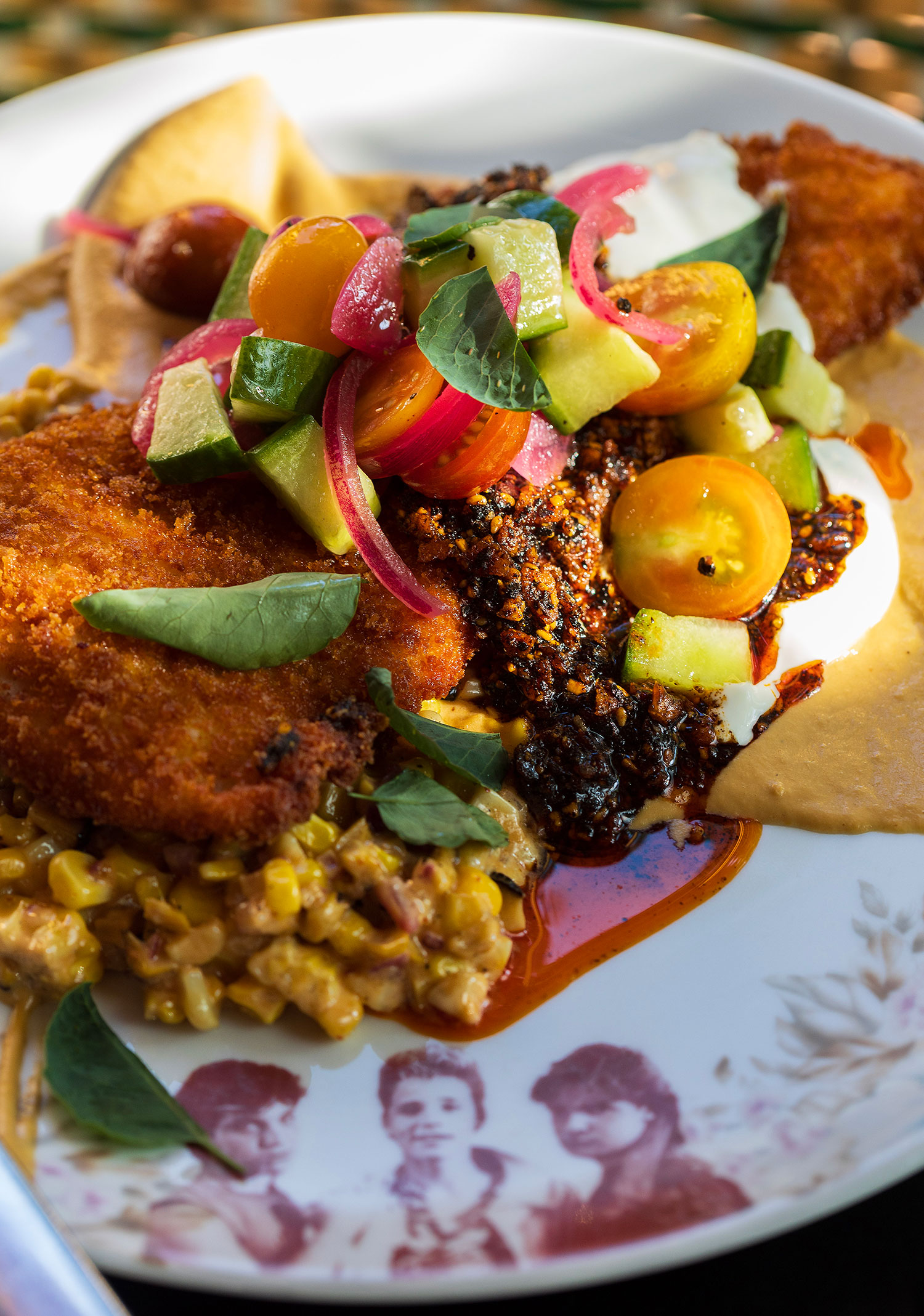
Fried cutlets atop a bed of creamed corn with pickled cucumber, cherry tomatoes, and a glossy chili crisp finish
The dining room doesn’t discriminate. Joseph says he once overheard a guest ask about the dress code and got the simple answer: “Shoes. Shirt.” Lawyers wander in straight from closing arguments. A couple arrives dressed to the nines at 10:30 p.m. every Saturday after the symphony. Somewhere in the mix are plenty of people who showed up in cutoff shorts and never really left. Joseph wants it that way. “We strive for a laid-back casualness. Come as you are.” At Stanbury, however you walk in is exactly how you are meant to be.
There are no chef’s whites in the kitchen, and no pretense. “We’re just cooking food,” Joseph says. “We don’t take ourselves that seriously.” Drew agrees and expands on the notion: “We want our actions to speak for themselves … but you can see right into the kitchen, so there’s nothing to hide. That’s very important to me.”
The staff has grown with the place, from three cooks in the early days to seven now, and the culture has followed. When Joseph’s young daughter comes to work, servers carry her around. “We all care about each other,” Drew says. The 2-year-old, meanwhile, has put away 17 oysters in three minutes.
The Bobcat Won
Then there’s the bobcat. Years ago in Louisiana, the story goes, Joseph and Will saw someone else shoot one near a bridge, convinced a relative to pull over, and found a taxidermist.
The bobcat followed him from his high school bedroom to his dorm room at Warren Wilson, and when it came time to decorate Stanbury, he wanted it up first.
Will objected. It would make the place feel “like a hunting club,” Drew recalls, and there were concerns it was going to “polarize the guests.” Drew himself says at the time he “could go either way.”
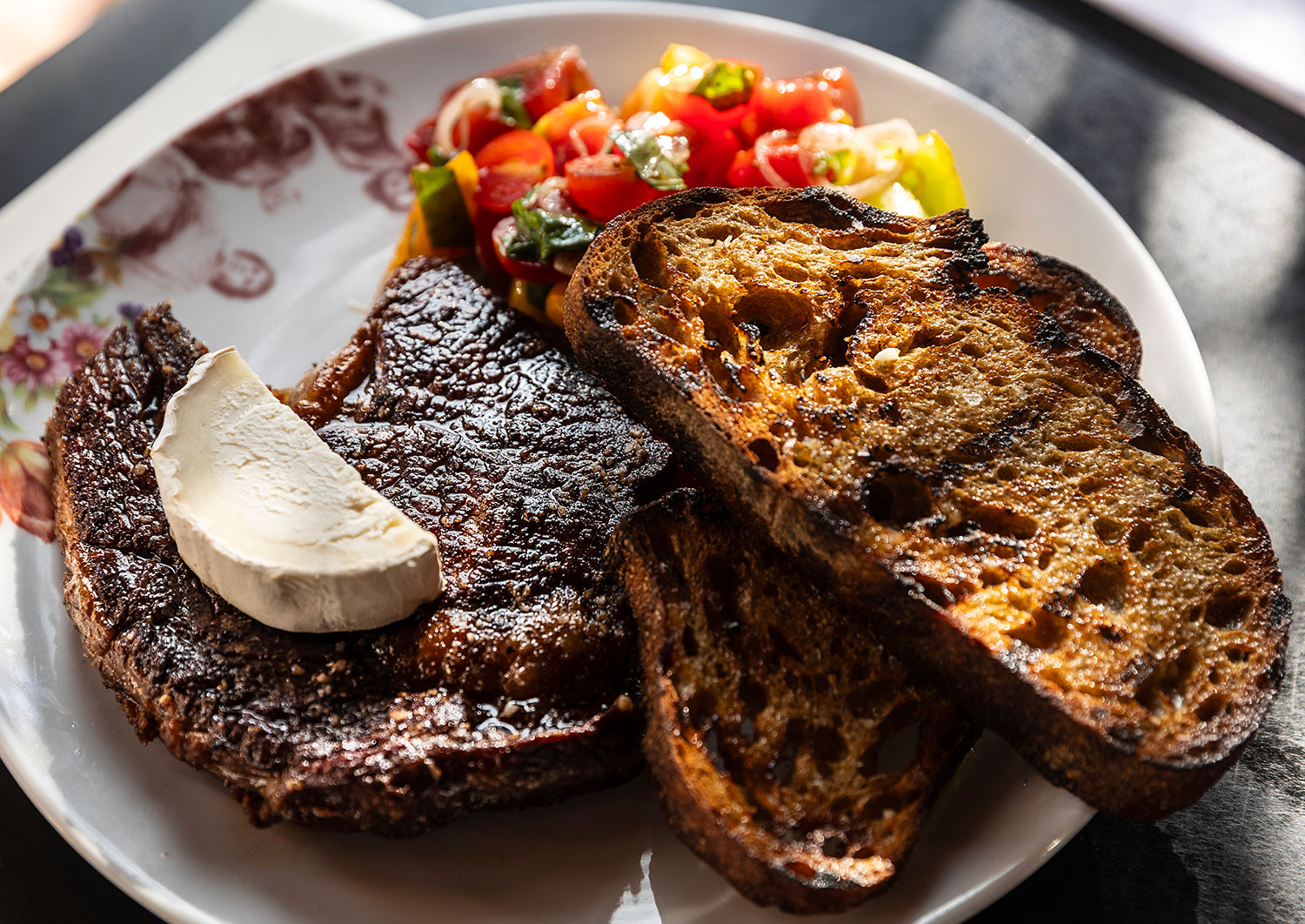
Charred to the edge, the rib eye gets a melting slice of soft cheese and side of grilled sourdough, along with a bright shallot-and-basil heirloom tomato salad.
The bobcat won.
“It was the first thing that went up here,” Joseph says. “A little like a superstition, but not a superstition. It makes me feel like home wherever I am.”
Which is how Drew got to watch his partners fight like actual brothers for the first time. “It was funny,” he says. Restaurants, Joseph explains, are “incredibly stressful,” but the greater partnership and friendship works like a marriage. “You plan on staying married,” he says. “You make it work. You can fight, but you make it work.”
Drew credits Will, who found the space, with making it all possible. “I’m incredibly grateful and indebted to him,” he says.
These days, Drew leaves much of the menu to sous chef Nick. (That includes “Nick’s mom’s salad dressing” on the mixed greens the day we stopped by.) Until about two and a half years ago, though, self-described “glorified line cook” Drew was in the kitchen every single day.
“I’m sort of joking,” he says, “but I feel like a chef now for the first time.” Compliment the chef, though, and he redirects: “It’s the food. It’s the feeling and the vibes. It’s the décor. It’s the staff.”
About what’s next, Joseph keeps it gray. “We’re doing something next door,” he says, in the space formerly occupied by Escazu — “something I’ve been excited about doing for a long time.” Something small and intimate and different.
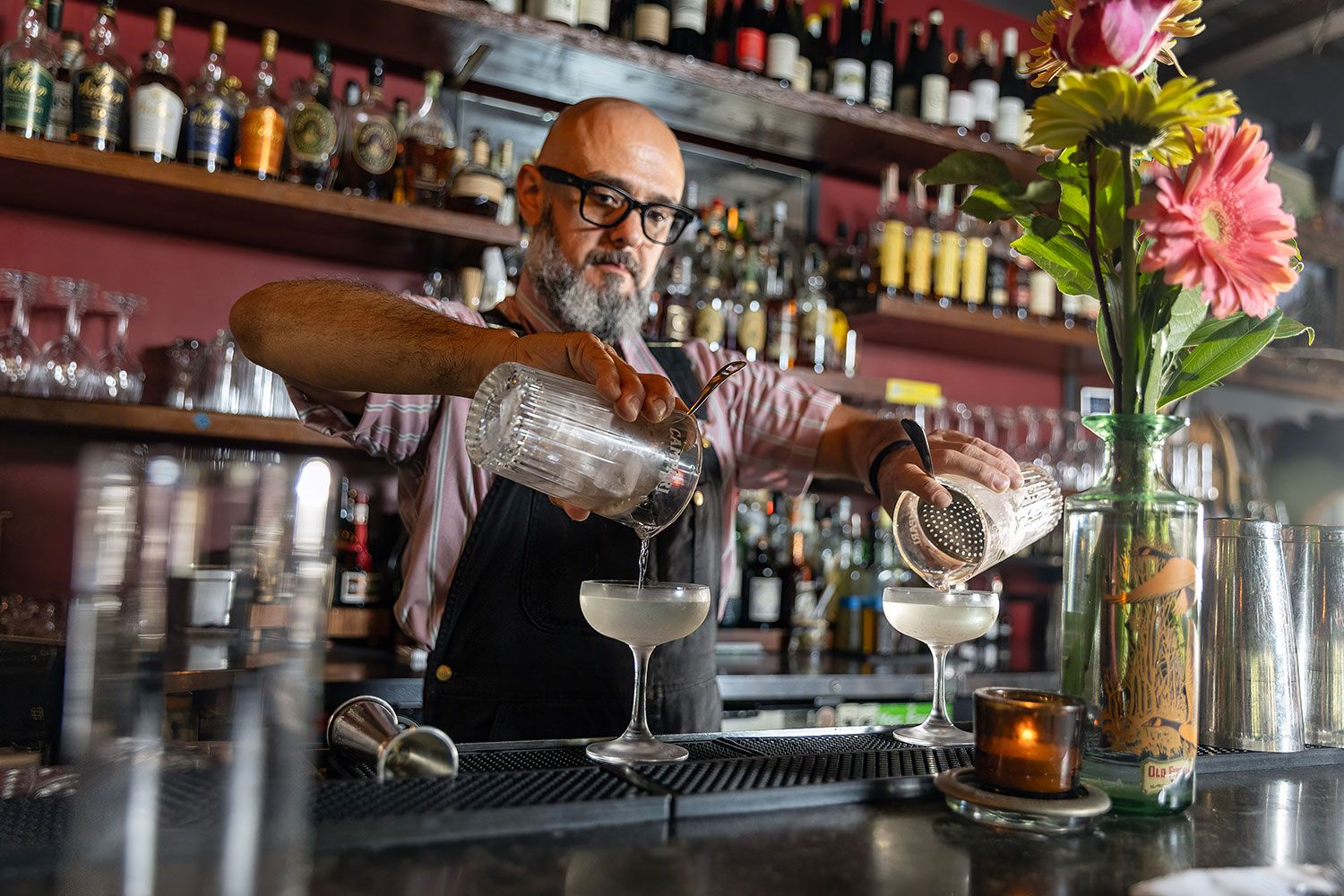
The “generous pour” at Stanbury extends past Joseph Jeffers’ complimentary shots.
“Stanbury won’t change, and it’ll just be a different concept,” he explains. “It’ll be smaller and tastier. We don’t want to open up a place just to open a place,” he says. “We wouldn’t do it if it wasn’t exciting.”
It may not be for everyone, and it’s just a street sign, of course. But it’s also what happens when someone in a scrapyard asks why not — and everyone else has the good sense to say yes.
stanburyraleigh.com
@stanburyraleigh

- Mrs. Claus Knows
- Out & About in Wake County: November/December 2026
- Say Yes to Stanbury
- Season’s Sips
- Recipes from Readers: Dark Chocolate Bourbon Brownies
- Liquid Assets: Cranberry Kölsch
- Garden Adventurer: Poinsettia Care Essentials: Earth, Wind, and Fire
- Small Business Spotlight: Alter Scalp Spa
- 2026 Gift Guide
- Pay It Forward: PORCH Cary
- Erica Chats: A New Type of Tradition